PortfolioCase study
UR-01Live · simulated fleet
Urja
The trip is done. Where did the money go?
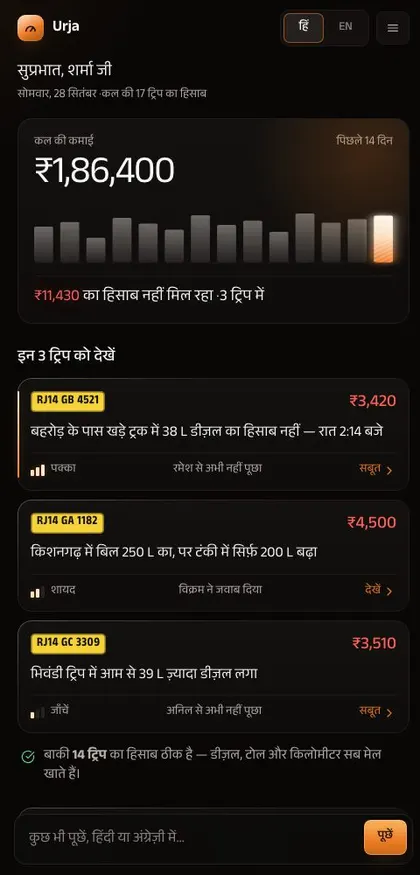
An AI munshi for small fleet owners: it reconciles each trip's diesel, tolls and km, and every morning tells the owner, in Hindi or English, which rupees don't add up and how sure it is.
5 rules
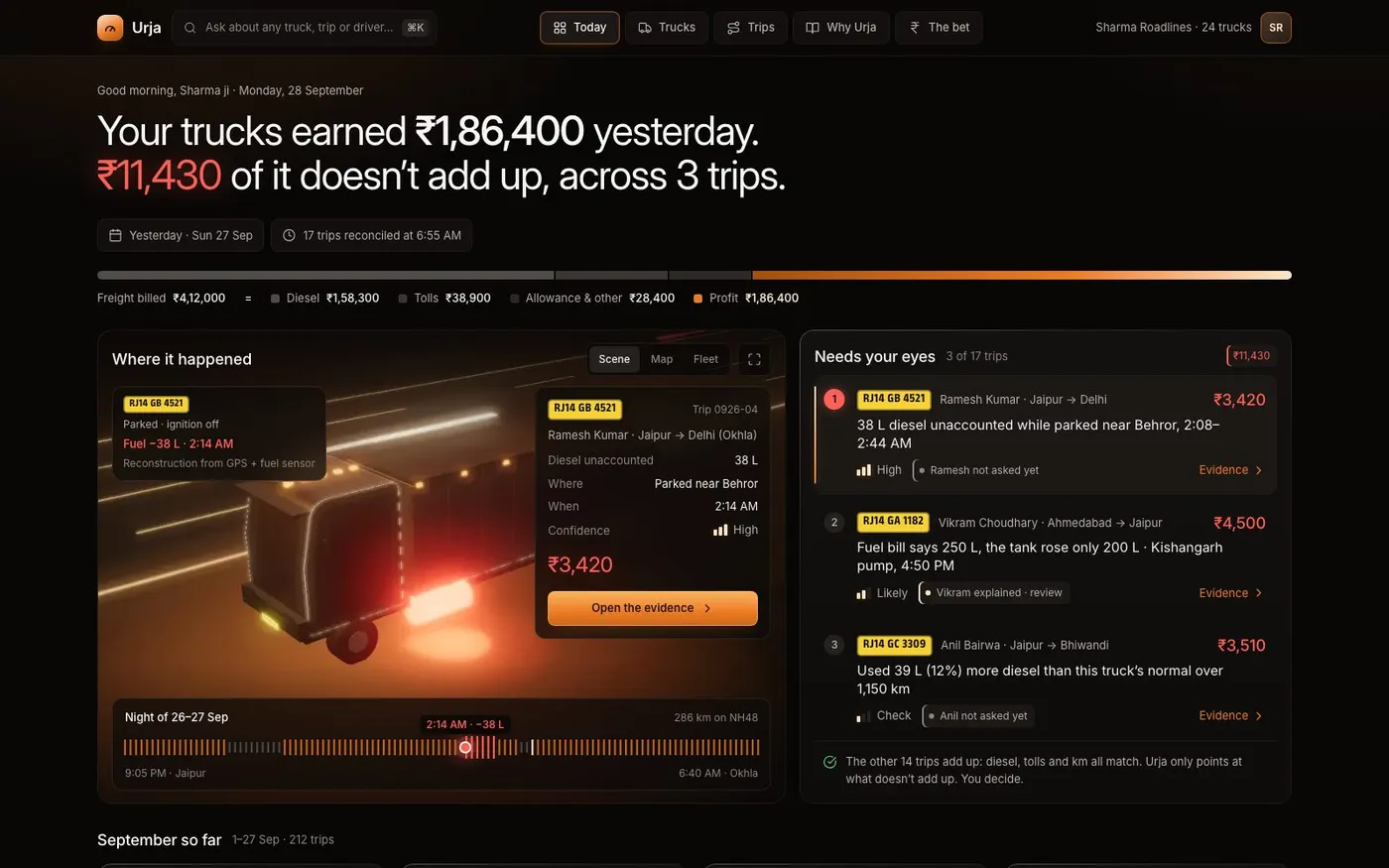
raise every flag, each with a confidence level
Structural
2 of 23
flags wrong in the simulated month, shown to the owner
Structural
The false-accusation guardrail is under 10%, and the product shows it as “When Urja was wrong”.
Evidence keyStructural
Why it exists
Diesel is the biggest cost, and the owner only sees it after the trip.
Owners of 10–100 trucks run the business from a phone and WhatsApp. Fuel is the largest operating cost, and vendor sources claim a large share of it leaks — directional figures, not proven ones. The owner's question is simpler: why did a finished trip make almost nothing?
The truck finished the trip — why did I make almost nothing?
The morning
Read the brief, open the evidence, ask the driver.
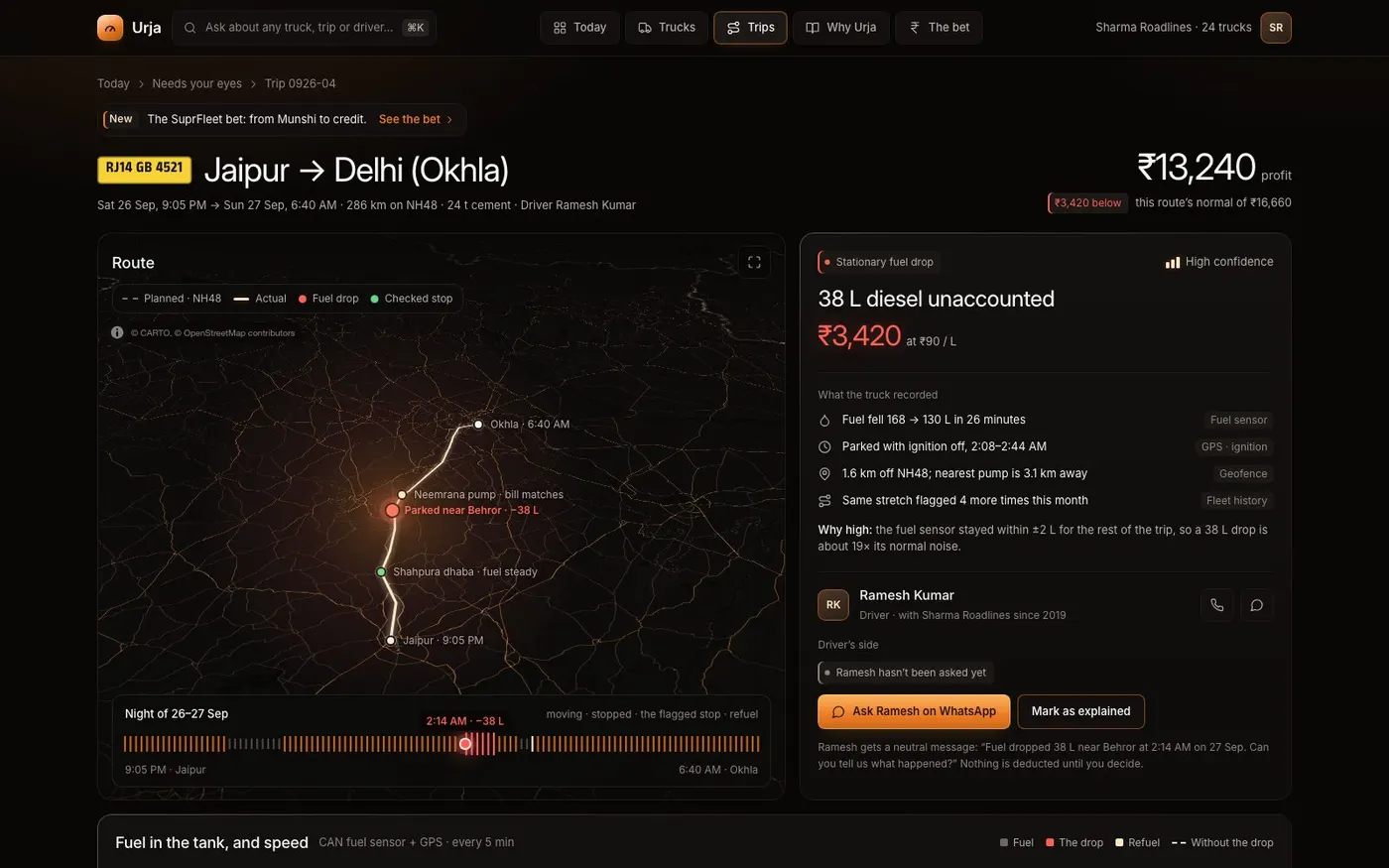
A morning brief in Hindi or English names the trips that don't add up. Each flag opens its evidence — the route, the fuel curve and what the truck recorded — with a confidence level and the driver's side, and nothing is deducted until the owner decides.
Decisions
Rules find the money; the model only answers questions.
- Could have
- A broad telemetry dashboard
- Chose
- One problem, found and explained
- Because
- Building is the cheap part; the work is finding the right problem for one owner.
- Could have
- Let a model find the leaks
- Chose
- Deterministic rules, with a live model only in Ask Urja
- Because
- A fully live design risked invented rupee figures and a fragile demo; rules make every figure explainable.
- Could have
- Measure engagement
- Chose
- ₹ recovered per truck, guarded by the false-accusation rate
- Because
- A flag that wrongly accuses a driver costs trust, so every flag shows its confidence and the driver's side.
How it works
From the truck's data to the owner's morning.
- Trip datafuel sensor, GPS, tolls, bills
- Five rulesfuel drop, refuel, km/L, route, toll
- Confidencehigh, likely or check
- Morning brieftemplated, Hindi or English
- Ask UrjaGemini, with a labelled fallback
Evidence
Live on a simulated fleet — no users yet.
Urja runs live on a fictional 24-truck fleet. 1,235 unit and 515 end-to-end tests passed and the security review found nothing. The Ask Urja eval did not pass: the final run hit the model's free-tier quota, so the live Ask box usually shows its fallback answer.
What isn’t measured
- No owners, trips or recoveries from a real fleet are recorded.
- The Ask Urja eval gate is recorded as failed.
- The Hindi copy has not had a native-speaker review.
Sources
Everything here is backed by a real artifact.
- Research
- PRD
- Design
- Evaluation
- Live data