PortfolioCase study
CB-01Built · not launched
Cubicle
Your first team fits in a cubicle.
One idea.Four visible teammates.Four artifacts.
A solo founder types an idea and watches four AI teammates debate it in the open — then gets the plan.
4
AI teammates
Prototype
PM · researcher · designer · developer
4
fixed artifacts
Prototype
PRD · scan · landing copy · build plan
10 days
buildathon
Structural
a team of six, Sept 7 → 16, 2026
Evidence keyMeasuredStructuralPrototype

The problem
Solo builders have no team — so ideas die before the first artifact.
AI tools answer in one generic voice and hide their reasoning. Nobody shows the “why”.
- An idea
- A generic AI prompt
- A generic PRD
- Low trust
- Nothing shippednever sent to anyone
“He has pasted the idea into ChatGPT three times and got three slightly different, equally generic PRDs that he never sent to anyone.”
The product
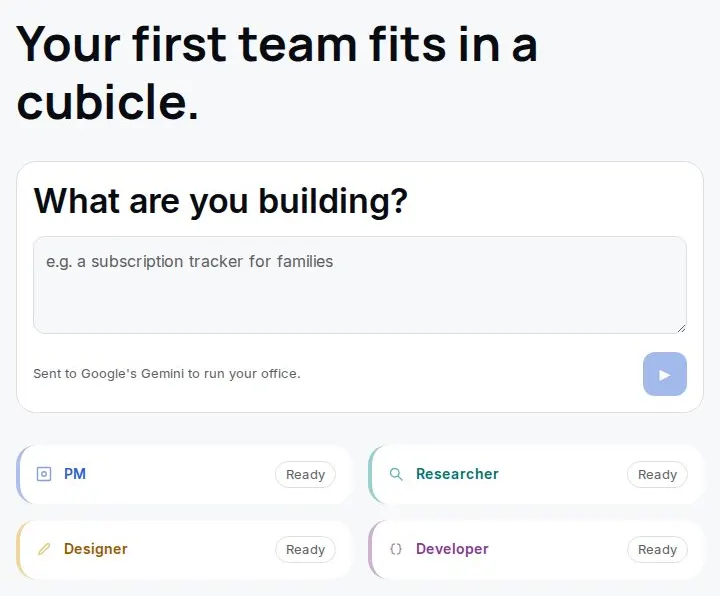
Type an idea. Watch the team argue. Get four artifacts.
The debate is the product: every proposal and objection is on screen before a deliverable is written.
- Idea
- Orchestratorpicks who speaks
- Team debatePM · research · design · dev
- Stop rule
- 4 artifacts
What every run prints
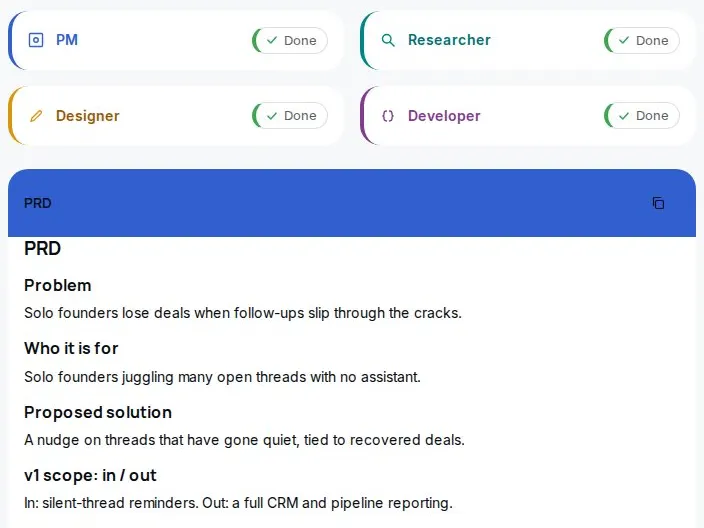
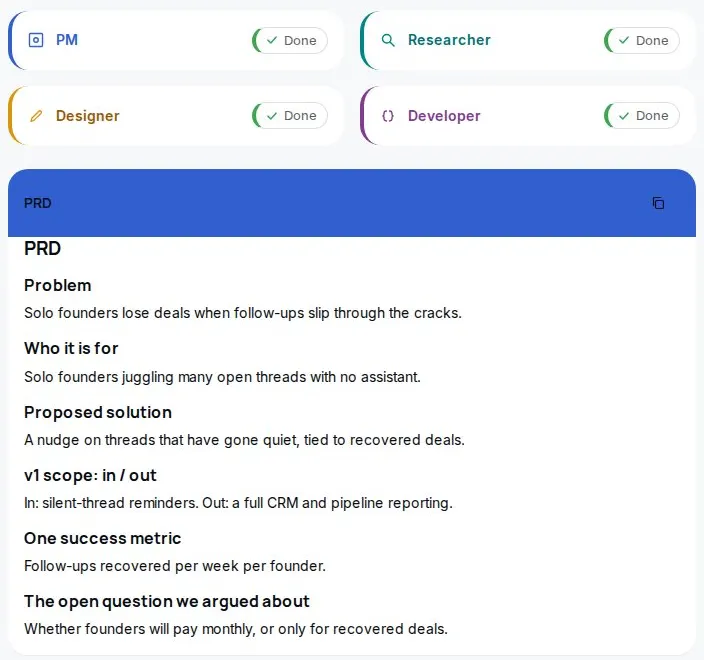
PRD
by the PM
- Problem
- Who it is for
- Proposed solution
- v1 scope: in / out
- One success metric
- The open question we argued about
Competitor scan
by the Researcher
- Three competitors
- What this means for positioning
- Confidence note
Landing copy
by the Designer
- Headline
- Subheadline
- Three benefits
- Call to action
- Two objections, answered
Build plan
by the Developer
- Smallest v1 slice
- Suggested stack
- Five steps with rough time
- What we cut and why
- Riskiest assumption to test first
Trust system
Trust first. Ownership second. Autonomy last.
- firstTrust
- secondOwnership
- lastAutonomy
- Could have
- Maximum agent autonomy
- Chose
- Visible debate first
- Because
- Founders need to see the reasoning before they hand over ownership.
- Ideatyped by the founder
- Orchestratorpicks the next speaker
- 4 role agentspropose · question · object
- Stop rules6 messages · 45 s
- 4 artifactswritten in parallel
- Databaseevery message saved
- Browsera live mirror
Key learnings
Three lessons from building Cubicle.
Visible reasoning creates trust
The product’s bet: a founder trusts a plan they watched being argued. Untested with users.
Bounded debate beats endless chat
Stop rules and four fixed artifacts keep a run’s cost and time bounded.
Read the diff, not only green checks
The two most important defects were found by reading the reasoning, not by any test.
Evidence
Built and tested offline — not launched.
The QA report’s verdict: “CONDITIONALLY READY — STEPS REQUIRED”.
326
automated tests passing
Measuredas of 12 Sep 2026
3 skipped; typecheck, lint and audit clean in CI
29 / 97
test cases passed
Measuredas of 12 Sep 2026
17 blocked · 48 planned
0
test cases failed
Measuredas of 12 Sep 2026
Not measured yet
- A real four-agent run on a live model
- Users or usage
- Live latency (50–75 s is an estimate)
- Real cost (≈ $0.04 a run is an estimate)
PrototypeNot launched
Source material
Everything here is backed by real artifacts.
- PRD
- Research
- Architecture
- Design
- Code
- Evaluation
- Build ledger